NEW YORK (AP) — When Jake Bauers gloved the final out of the Milwaukee Brewers' first World Series triumph, it might have ended the last Major League Baseball game for a long time.
While just 148 days remain until the scheduled start of the 2027 season on March 24, owners have proposed a salary cap for the first time since their 1994 plan led to a 7 1/2-month strike and the first cancellation of the World Series in 90 years.
“Obviously, you’d love to see the game be in a good spot and continue to be played,” Milwaukee captain Christian Yelich said Wednesday a few hours before his team finished a five-game victory over Tampa Bay. “I think the game’s in a great spot right now with a lot of people tuned in, a lot of popularity, a lot of great players out there. It would obviously be a shame if we miss time, but we’ll have plenty of time this offseason to talk about it.”
Free agent frenzy possible ahead of lockout
Baseball's five-year labor contract, agreed to in March 2022 on the 99th day of a management lockout, expires on Dec. 1. MLB is likely to lock out players again as soon as the deal expires.
That could create another free-agent frenzy ahead of the expiration. On Dec. 1, 2021, clubs committed to $1.4 billion in salaries that included nine-figure contracts for Javier Báez, Byron Buxton, Kevin Gausman, Max Scherzer, Corey Seager and Marcus Semien.
This year's free-agent class is headed by Tarik Skubal, Freddy Peralta, Michael King, Seiya Suzuki and Randy Arozarena. There were 144 new free agents Thursday and several dozen more can go free by Monday.
Players say cap proposal is a non-starter
While the sides have been negotiating since May, there is no common ground on the primary economic issues.
Management wants a cap and a floor that would cut down disparity in payrolls along with restricting a player to at most 15% of his team's payroll.
Players want expanded free agency and salary arbitration rights along with almost doubling the major league minimum, increasing the money high-revenue teams share with the less-wealthy clubs and imposing a tax on teams that fail to keep their payrolls at a certain level.
During bargaining that led to the 2022 agreement, the sides didn't engage in extensive back-and-forth on economic proposals until late February, when the possibility of losing regular-season games neared. Several deadlines passed before the deal was reached, and opening day was pushed back from March 31 to April 7.
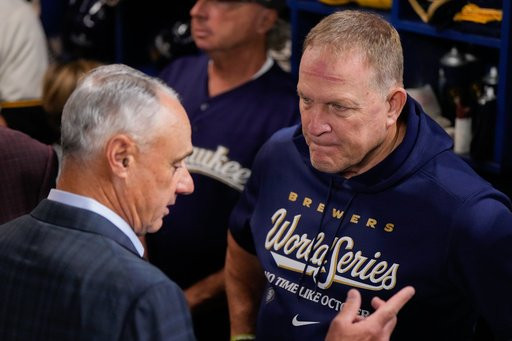
“I am not, by nature or sort of intellect a deadline bargainer,” baseball Commissioner Rob Manfred said. “I think in recent years it has become more deadline driven, which is not uncommon."
Other major US leagues have caps
While the NBA has had a cap since 1984-85, the NFL since 1994 and the NHL since 2005-06, baseball players have said they never will agree to such a system. They have been preparing for several years for a lockout and a fight on a cap proposal.
"I think everybody knows where we’re headed come Dec. 1," Tampa Bay pitcher Pete Fairbanks, a member of the union's eight-man executive subcommittee, said last April. “We’ve been through this song and dance before.”
Owners say they are united on their cap plan and MLB says it would benefit the majority of players who make close to the minimum. About 40% of the players on 40-man rosters at the end of the regular season had less than one year of major league service as of the start of the season.
The union says the current system of free agency, arbitration and no hard spending limit allows players to realize their economic worth.
Change in union leadership
Players forced out union head Tony Clark early this year and replaced the former All-Star first baseman with his deputy, Bruce Meyer, the lawyer who led their negotiating team for the last CBA. When the union agreed to the current deal, the executive subcommittee voted against it but team player representatives voted 26-4 in favor for an overall 26-12 approval.
Skubal, Fairbanks, Chris Bassitt and Paul Skenes joined the executive subcommittee in December 2024 along with Jake Cronenworth and Cedric Mullins. Semien is the only holdover from the 2021-22 talks on the subcommittee, which also includes Brent Suter.
“We have made massive, massive strides in just educating players, keeping players together,” Bassitt said. "It's not like the executive board is made up of eight guys and you follow that eight guys. Now it's all 30 teams pulling from the same rope, so to speak and it's every player under that umbrella."
___
This story has been updated to correct that Tarik Skubal, Pete Fairbanks, Chris Bassitt and Paul Skenes joined the executive subcommittee in December 2024, not 2004.
___