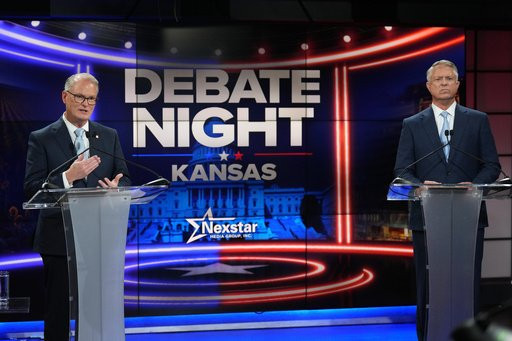
WASHINGTON (AP) — Kansas Democrats are looking to Methodist megachurch pastor Adam Hamilton to pull off what no one from their party has done since 1932: win one of the state’s U.S. Senate seats.
Hamilton is challenging U.S. Sen. Roger Marshall as the Republican incumbent seeks a second term. Voters in the Sunflower State will also elect a new governor and decide a full slate of federal and state contests.
Republicans hold a 53-47 Senate majority, but control of the chamber is increasingly in play as Democratic candidates have waged stronger-than-expected challenges in heavily Republican states once considered beyond their reach, including Alaska, Iowa, Kansas and Texas.
Marshall was elected in 2020 with 53% of the vote to replace longtime Republican U.S. Sen. Pat Roberts. He faced nominal opposition in the Aug. 4 primary, receiving about 80% of the vote. Hamilton faced a much more crowded primary, placing first with about 35% of the vote against 10 other candidates.
Marshall has faced headwinds in a midterm campaign environment that historically has punished the president’s party at the ballot box. Across the nation, a majority of voters seek change in Washington, according to AP-NORC polling. Disapproval of President Donald Trump’s handling of high prices and the war in Iran has put a drag on Republican candidates in key contests despite an influx of cash from deep-pocketed outside groups, including one affiliated with tech billionaire Elon Musk.
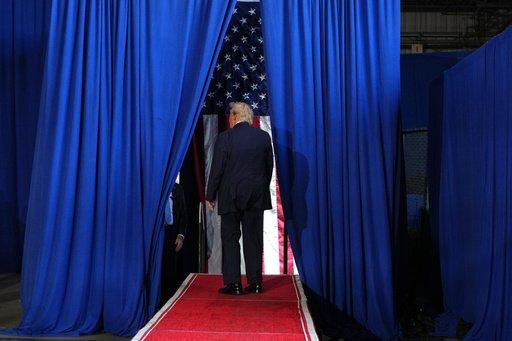
Hamilton has far outpaced Marshall in campaign fundraising, almost tripling the incumbent's total haul and cash on hand as of Oct. 14. National Republican leaders have redirected campaign funds from the U.S. Senate race in North Carolina to boost Marshall in Kansas. Trump and Vice President JD Vance have made a combined three trips to Kansas to campaign for Marshall since the president announced his midterm campaign push in September.
The race for governor is a top pick-up opportunity for Republicans, with Democratic Gov. Laura Kelly barred from seeking a third term. Although Kansas has voted reliably Republican in statewide federal contests, the state also has a 60-year streak of electing governors from the opposite party of their immediate predecessors.
State Senate President Ty Masterson is the Republican nominee. He won the crowded, seven-candidate Aug. 4 primary with about 43% of the vote, aided by a Trump endorsement. The Democratic nominee is state Sen. Cindy Holscher. In the primary, she was heavily outspent by fellow state Sen. Ethan Corson, who had Kelly’s endorsement. But Holscher prevailed with about 49% of the vote against Corson and Overland Park Mayor Curt Skoog.
In statewide elections, Republicans typically amass large wins in small, rural counties across the state, while Democrats tend to do best in Kansas City and Topeka and the surrounding areas.
Trump carried the state in his three presidential campaigns, receiving about 57% of the Kansas vote in 2024.
In their 2020 and 2024 presidential campaigns, Democrats Joe Biden and Kamala Harris each carried the same five counties, among the largest in the state: Johnson in the Kansas City suburbs, Shawnee and Douglas in the Topeka area, Kansas City-based Wyandotte, and Riley. Neither candidate surpassed the 42% mark statewide.
Kelly’s two wins as governor in 2018 and 2022 show a possible path for Hamilton to follow. In addition to the five counties that make up the state’s Democratic base, she also carried Sedgwick County in the Wichita area.
Here are some of the key facts about the election and data points the AP Decision Team will monitor as the votes are tallied:
When do polls close?
Polls close at 7 p.m. local time, which is 8 p.m. and 9 p.m. ET. Polls in most of the state are in the Central time zone and close at 8 p.m. ET, but some polls are in Mountain time and close at 9 p.m. ET.
What’s on the ballot?
The Associated Press will provide vote results and declare winners for U.S. Senate, U.S. House, governor, secretary of state, attorney general, insurance commission, state board of education, state House and a statewide ballot measure.
How many people voted in the last midterm election?
More than 1 million votes were cast in the 2022 Senate race in Kansas.
How much of the vote is cast early or by absentee ballot?
About 40% of the vote in the 2022 Senate race was cast early, in-person or by mail.
The latest advance vote totals for Kansas can be found in the AP’s advance vote tracker.
When are early and absentee votes released?
Mail ballots may be processed before Election Day. Tabulation may also begin but the final count may not be completed until Election Day.
Almost every Kansas county is expected to release all or almost all of their results from early in-person and mail voting in their first vote updates of the night. About a third of counties also are expected to release all or almost all of their in-person Election Day results in their first updates as well. More than half of counties are not expected to release any in-person Election Day results in their first update.
How long does vote counting usually take?
In the 2024 general election, the AP first reported results at 8:10 p.m. ET, or 10 minutes after most polls closed. The vote count reached the halfway point at 9:48 p.m. ET. The last vote update of the night was at 3:45 a.m. ET with about 97% of total votes counted.
When will the AP declare a winner?
The AP does not make projections and will declare a winner only when it’s determined there is no scenario that would allow a trailing candidate to close the gap. If a race has not been called, the AP will continue to cover any newsworthy developments, such as candidate concessions or declarations of victory. In doing so, the AP will make clear that it has not yet declared a winner and explain why.
How do recounts work?
There are no automatic recounts in Kansas, but candidates may request and pay for one regardless of the vote margin. If the candidate requesting the recount is declared the winner or if the vote margin in a general election is less than 0.5%, the fee is waived. A post-election manual audit is conducted in 1% of precincts for selected races. In even-numbered election years, selected federal, statewide and legislative races are subject to an audit of 10% of precincts if the vote margin is within 1% of total votes cast. The AP may declare a winner in a race that is subject to a recount if it can determine the lead is too large for a recount or legal challenge to change the outcome.
___
Follow the AP’s coverage of the 2026 election at https://apnews.com/projects/elections-2026/.